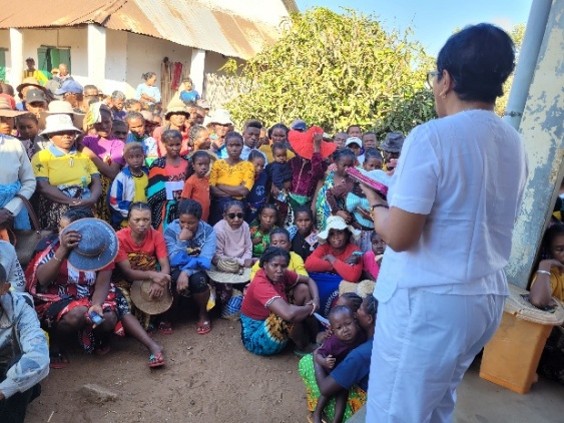
As with previous missions to Nosy Varika, the team travelled in two groups. One made the long journey by road to Mahanoro before crossing the Mangoro River by passenger boat, arriving on Saturday afternoon. The second group travelled by air, arriving on Monday.
Although the team initially enjoyed good weather and were able to visit the town mayor and district chief, conditions quickly deteriorated. Heavy overnight rain flooded much of their campsite, forcing some team members to seek accommodation in a hotel or a small room provided by the hospital. Three remained at the campsite with the damp tents and equipment.
The official launch took place in pouring rain, discouraging attendance despite the mayor’s presence. Communication was also difficult, as the local radio station did not become operational until Wednesday evening, limiting opportunities to publicise the mission.
Many patients in rural Nosy Varika rely on dugout canoes to reach the hospital, but the severe weather made travel impossible for some, resulting in lower attendance than usual.
The first two mornings were particularly quiet, but as the rain eased in the afternoons, more patients arrived, some having travelled between two and four hours by boat.
Hypertension and malaria were among the most common conditions treated, while children primarily presented with diarrhoea and flu. Ultrasound services also attracted significant numbers of patients.
Throughout the mission, the team worked closely with local hospital staff, particularly the medical inspector and chief physician, whose support helped overcome minor difficulties.
Stories from the Mission
One of the patients was Liva, a 27-year-old woman who had been waiting several days for surgery she could not afford.
A year earlier, Liva had lost her baby during pregnancy and undergone surgery from which she had never fully recovered. Unable to afford further treatment, she returned to her parents, who cared for her with the limited resources available. As her condition worsened, they brought her to the hospital.
The MMS surgeons were able to operate on Tuesday afternoon, but tragically discovered cancer that they could do little to treat. Liva sadly passed away the following day, having received prayers from a pastor visiting with MAF.
Her story highlights the devastating consequences of limited access to affordable healthcare in remote communities.
There were also moments of hope. The surgical team successfully performed a Caesarean section on a woman with dwarfism, safely delivering a baby girl without complications.
On Wednesday, the team welcomed six visitors from MAF Norway, accompanied by a pilot and pastor from MAF Madagascar, who came to observe the MMS operations.
The return journey brought further challenges. A delayed MAF flight meant some team members had to stay an additional night, while those travelling by road were forced to use a slow cargo boat after being unable to find a passenger boat on Friday. The road team eventually returned on Sunday morning.
Statistics - Total 481

Despite the relentless rain, reduced patient attendance and considerable logistical challenges, the mission was a success.
The team’s determination, alongside the support of local hospital staff, ensured that vital medical services reached patients who might otherwise struggle to access the care they need.